
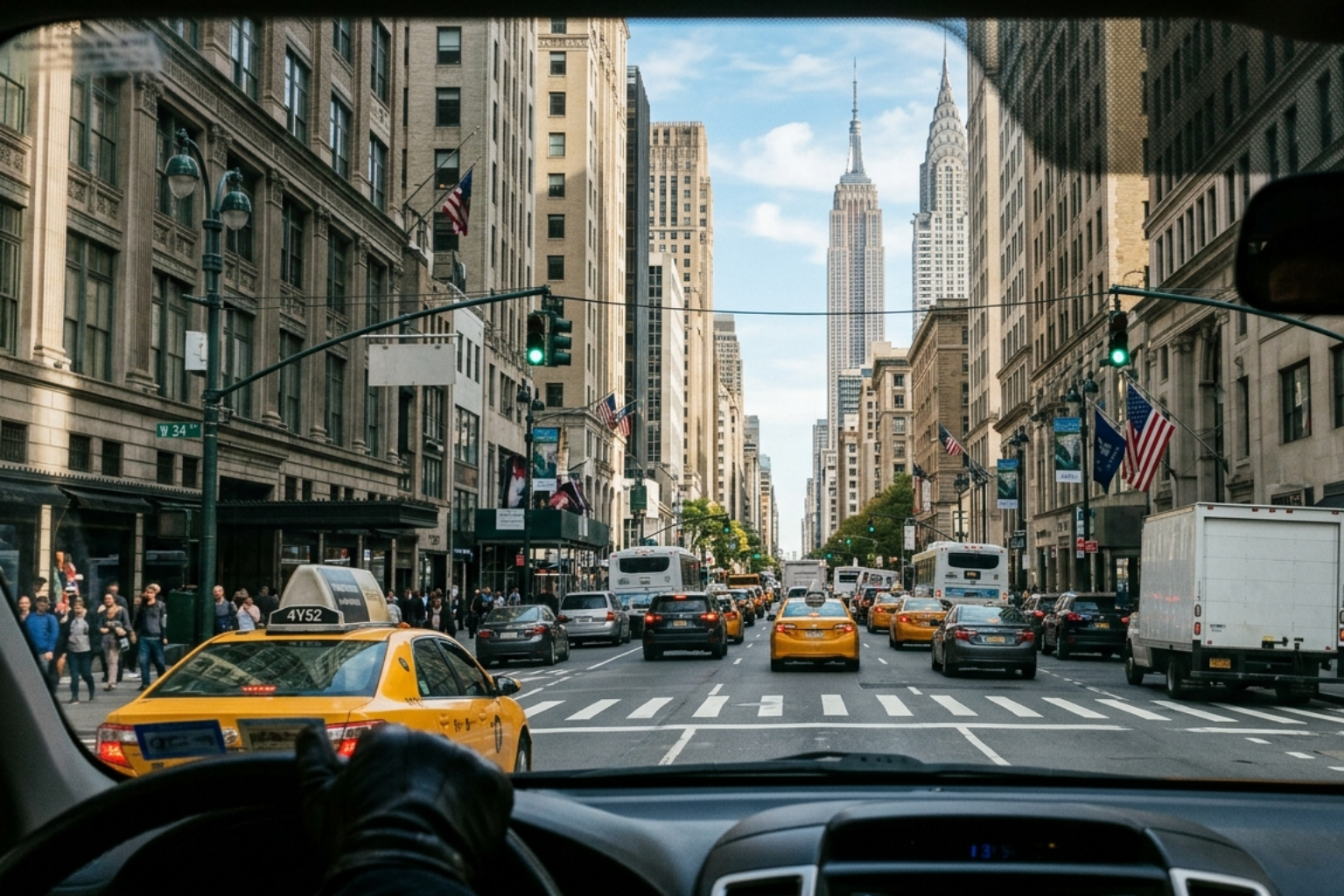
Driving in Queens vs. Manhattan: What Feels Different and How to Adapt Fast
If you ask any seasoned driver in New York City, they’ll tell you that the five boroughs might as well be five different countries when you’re behind the wheel.
But nowhere is this contrast sharper than when you cross the East River.
Transitioning from the sprawling, multi-layered layout of Queens to the high-stakes, hyper-congested grid of Manhattan is a major milestone for any student driver. At VMARE Driving School, we see this transition trip up even the most promising students.
Here is exactly how the driving psychology shifts between these two boroughs—and the expert techniques you need to adapt instantly.
1. The Grid vs. The Maze: Understanding the Layout
The first thing you will notice is how differently space and navigation feel.
Manhattan: The Strict Grid
Manhattan is a predictable, relentless grid. The streets run east-west, the avenues run north-south, and almost everything is one-way.
The Trap: Because of the grid, missing a turn means you can't just make a quick block. You often have to loop around several highly congested avenues just to get back on track.
How to Adapt:Look two steps ahead. Do not just focus on the car directly in front of you. Read the avenue signs early, anticipate which lane you need to be in at least three blocks in advance, and never change lanes at the last second.
Queens: The Multi-Layered Maze
Queens is the largest borough by area, and its layout is notoriously complex. You’ll navigate a mix of residential avenues, massive commercial thoroughfares (like Queens Boulevard, famously dubbed the "Boulevard of Death" in decades past), and elevated train pillars (the El) cutting through neighborhoods like Astoria and Jamaica.
The Trap: Visual obstructions are everywhere. The steel pillars of the elevated subway lines cast deep shadows, create blind spots, and suddenly narrow your driving lanes.
How to Adapt:Master your lane positioning. When driving under the El, stay centered. Expect pedestrians to step out from behind the steel pillars, and keep your speed strictly regulated.
2. Space Management: Squeezing Past vs. "Blocking the Box"
How you use the space around your vehicle changes dramatically depending on which side of the river you are on.
NYC DRIVING RULE #1
"Right on Red" is strictly ILLEGAL across all five boroughs unless a sign explicitly permits it. Assume you cannot turn.
Manhattan: The Battle of "The Box"
In Manhattan, gridlock is a constant threat.
The Rule: You must never "Block the Box"—which means entering an intersection unless there is clear space for your vehicle on the other side. If the light turns red while you are stuck in the middle, you face heavy fines and a chorus of angry horns.
How to Adapt: Before pulling into any intersection, look at the vehicle in front of you. If they don't have room to clear the intersection completely, you must wait behind the white stop line, even if your light is green.
Queens: Navigating the Double-Park Obstacle Course
In Queens, street space is dominated by double-parked delivery trucks, buses, and active loading zones.
The Rule: You will constantly have to merge out of your lane to go around parked obstacles.
How to Adapt: Don’t wait until you’re bumper-to-bumper with a double-parked truck to signal. Check your mirrors early, use your turn signal to communicate your intent, and smoothly merge into the adjacent lane.
3. Pedestrian and Cyclist Density: The Unpredictability Factor
The level of distraction outside your windshield requires a total shift in mental focus when moving between these boroughs.
FeatureQueensManhattanPedestrian FlowConcentrated around subway hubs and commercial strips.Relentless, jaywalking, and highly distracted.Cyclist/Scooter ActivityModerate, primarily utilizing designated bike lanes.High density of delivery e-bikes weaving through active traffic.Double ParkingFrequent on residential and commercial streets.Heavy commercial vehicle loading; strictly enforced.
In Manhattan, pedestrians view crosswalk signals as "suggestions". You must develop active scanning habits—sweeping your eyes from left to right across every single crosswalk before making a turn. In Queens, you must remain highly alert around school zones, residential driveways, and local bus stops.
4. Parallel Parking: Tight vs. Microscopic
No NYC driving discussion is complete without mentioning the ultimate test of skill: parallel parking.
In Queens: You can often find decent-sized spots, but you must keep an eye out for Alternate Side Parking street cleaning rules and local driveway curb cuts (blocking one is an instant ticket or tow).
In Manhattan: Spots are practically microscopic, and competition is fierce. If you find a legal spot, you need to be able to lock it down quickly and smoothly without holding up a line of 20 honking cars.
The VMARE Golden Rule for Parallel Parking:
Pull up parallel to the vehicle in front of the space, about two feet away, aligning your rear bumper with theirs. Turn your wheel completely toward the curb and back up at a 45-degree angle until your front door clears their rear bumper. Gently cut the wheel the other way to swing the front nose in. Keep it slow and controlled—touching the curb on a New York road test is an automatic fail!
To see this exact spatial alignment in action, watch this step-by-step breakdown:
Get Road-Ready with VMARE Driving School
Whether you are trying to conquer the elevated train pillars of Queens or the fast-paced, high-pressure avenues of Manhattan, reading about it is only the first step. The only way to build true muscle memory and adaptive driving instincts is through targeted behind-the-wheel training.
At VMARE Driving School, our expert, patient instructors specialize in preparing you for the real-world chaos of NYC roads. We teach you the defensive driving techniques, parallel parking formulas, and spatial awareness tricks that will make you a confident driver anywhere in the five boroughs.
Don't let NYC traffic intimidate you. Schedule your first lesson with VMARE today and master the streets of New York!
