
Why Hazard Perception Training Is the Most Important Skill for New Drivers
Passing your DMV road test is a major milestone, but earning a driver's license doesn't automatically mean you are prepared for the unpredictable realities of modern urban transit. In a high-stakes, densely populated environment like New York City, vehicle control is only half the battle. The true differentiator between a safe motorist and an accident statistic is hazard perception.
For new drivers navigating the East Side (ES), West Side (WS), Manhattan, and Queens, learning how to scan, identify, and mitigate risks before they materialize is the ultimate safety mechanism. At VMARE Driving School, we prioritize hazard perception training as the foundational pillar of our curriculum, transforming anxious beginners into proactive, collision-free drivers.
What is Hazard Perception Training?
Hazard perception is the cognitive ability of a driver to anticipate potentially dangerous situations on the road and react in time to avoid them. Unlike basic vehicle maneuvering—which involves mechanical actions like steering, braking, and parallel parking—hazard perception is an advanced mental skill. It requires constant visual scanning, cognitive processing, and situational awareness.
According to comprehensive traffic safety research, it takes an average of 1.5 to 2.5 seconds for an untrained driver to recognize a hazard and apply the brakes. At 35 MPH, a vehicle travels over 50 feet per second. Those few lost seconds can mean the difference between a safe stop and a catastrophic multi-car collision on the Long Island Expressway or the FDR Drive.
The Science of Safety: How Spotting Risks Early Prevents Accidents
New drivers are statistically involved in more accidents not because they lack the physical coordination to steer, but because they suffer from "hazard blindness." Beginner motorists tend to look directly in front of their bumper, focusing heavily on staying centered within their lane. Experienced drivers, conversely, utilize expansive visual scanning patterns, reading the road 10 to 15 seconds ahead.
By identifying a developing hazard early—such as a delivery truck double-parked on a blind curve in Queens, a pedestrian stepping out from between vehicles on the Upper West Side, or a cyclist swerving to avoid an open car door in Manhattan—you give yourself time to adapt. Early detection allows you to ease off the accelerator, hover your foot over the brake, or change lanes seamlessly, entirely eliminating the need for emergency, panic-induced maneuvers. Hazard perception isn't about reacting fast when something goes wrong; it's about altering your speed and positioning early so that nothing goes wrong in the first place.
The NYC Gauntlet: Why Manhattan & Queens Demand Elite Cognitive Training
Driving in New York City is uniquely demanding. Traditional driving programs designed for quiet suburban roads fail to prepare students for the chaotic sensory overload of the five boroughs. Each sector brings its own set of dynamic hazards that require specialized training:
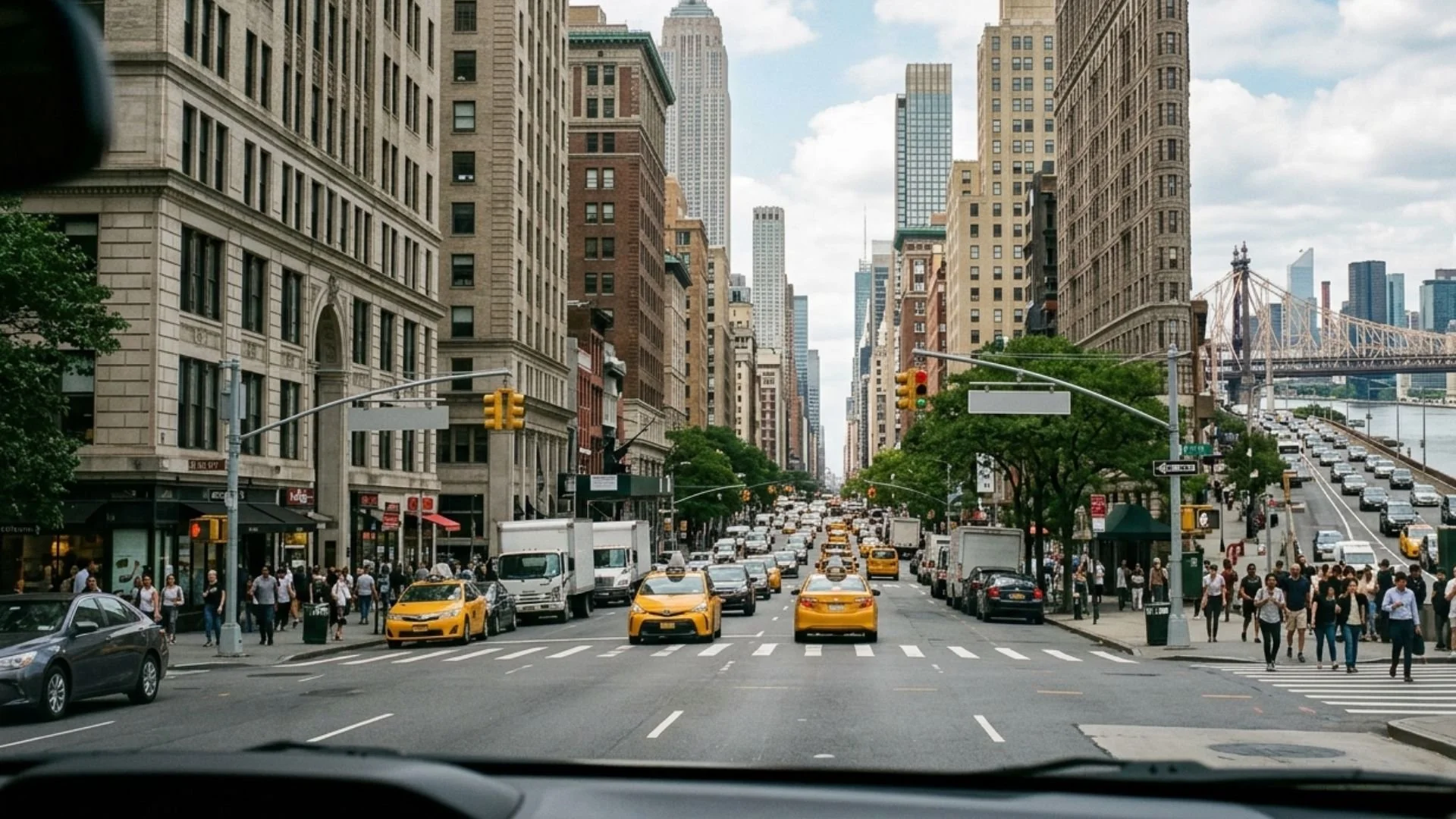
The West Side (WS) & Manhattan Grid: Flooded with yellow cabs, aggressive rideshare drivers, tourists distracted by navigation apps, and waves of commuters. Sudden stops, illegal U-turns, and jaywalking are continuous threats.
The East Side (ES) & Cross-Town Corridors: Construction zones, narrow lanes, heavy commercial vehicles, and tight visibility around arterial bridge exits require hyper-focused spatial scanning.
Queens Neighborhoods: From the multi-lane complexity of Queens Boulevard to congested residential streets crowded with parked cars on both sides, drivers must constantly monitor blind spots, emerging children, and unpredictable double-parked delivery vans.
How VMARE Driving School Builds Masterful Hazard Perception
At VMARE Driving School, we don't just teach you how to pass the road test; we teach you how to survive and thrive on NYC streets. Our proprietary training methodology systematically builds your hazard-detection capabilities through targeted, practical application.
1. Advanced Eye-Movement Training (The 15-Second Horizon)
We train our students' eyes to abandon "tunnel vision." Your VMARE driving instructor will teach you the rule of the 15-second visual lead, showing you how to scan the horizon, check mirrors dynamically every 5 to 8 seconds, and read the subtle body language of surrounding traffic.
2. Deciphering "Clues" and Pre-Hazards
Hazards rarely appear without warning signs. We teach our students to read the road like a map of clues. White reverse lights on a parked car mean it's about to back out. A puff of exhaust from a stationary vehicle indicates it's about to pull into traffic. A bouncing ball always precedes a running child. By recognizing these pre-hazards, our students stay miles ahead of the danger curve.
3. The "What-If" Mental Framework
During our behind-the-wheel lessons in Manhattan and Queens, instructors utilize interactive cognitive coaching. We prompt students with real-time "What-If" scenarios. "What if that city bus pulls out right now?" "What if that pedestrian doesn't look before crossing?" This conditions the brain to automatically map out emergency exit routes and defensive adjustments as a natural habit.
4. Urban Micro-Climate Exposure
We deliberately conduct lessons across diverse NYC terrains—including high-density intersections, complex roundabouts, and fast-moving parkways. Experiencing the distinct pressures of both the West Side and Queens under the guided supervision of a certified expert builds durable confidence that cannot be replicated in an empty parking lot.
Invest in Your Safety with NYC's Premier Driving Instructors
Driving is an empowering life skill, but it comes with immense responsibility. Don't leave your safety—or the safety of others—to chance. Mechanical skills will get your car moving, but hazard perception training will bring you home safely every single night.
Whether you are a teenager preparing for your very first license, an adult learner looking to master the Manhattan grid, or a new resident adapting to the frenetic pace of Queens, VMARE Driving School provides the elite, comprehensive coaching you deserve.
Ready to Become a Confident, Safe, and Proactive NYC Driver?
Don't just learn to drive—learn to anticipate. Secure your personalized behind-the-wheel lesson with our expert instructors today. Servicing Manhattan, Queens, and the East/West Sides.
