
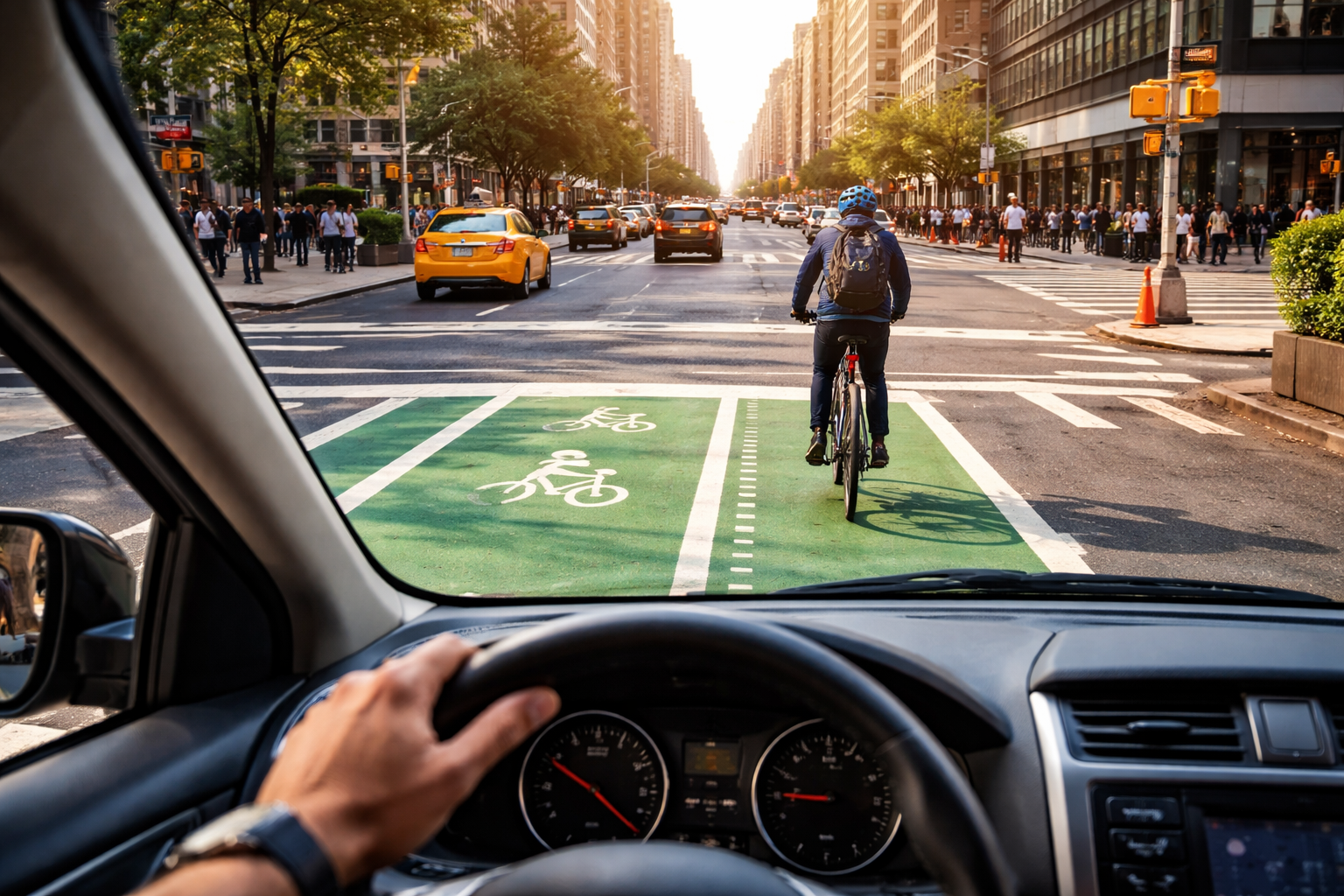
Bike Lanes & Cyclists: The Exact Checks Students Must Make Before Turning
If you’re learning to drive in New York City, one mistake can instantly fail your road test: turning across a bike lane without proper observation. With thousands of cyclists commuting daily in Manhattan, Brooklyn, Queens, and the Bronx, examiners expect precision—not guesswork.
At VMARE Driving School, we train students to execute turns with structured scanning patterns, correct yielding behavior, and full situational awareness. This guide breaks down the exact checks you must perform before turning across a bike lane in NYC.
Why Bike Lane Awareness Is Critical in NYC
NYC has an extensive network of protected and painted bike lanes. Many are physically separated by barriers, parked cars, or green paint markings. Cyclists often travel at 15–25 mph—faster than most students anticipate.
When you turn without checking thoroughly:
You risk a collision.
You fail your road test.
You create a liability situation.
Under New York traffic law, drivers must yield to cyclists when crossing a bike lane to turn. The cyclist has the right of way if traveling straight.
The 6 Exact Checks Before Turning Across a Bike Lane
This is the VMARE step-by-step protocol we drill into our students.
1. Early Mirror Check (8–10 Seconds Before the Turn)
Before signaling, check:
Rearview mirror
Side mirror on the turning side
You are looking for:
A cyclist approaching quickly from behind
A vehicle attempting to pass
Traffic conditions affecting your lane position
Failing to check mirrors early is a common road test deduction.
2. Signal Early and Clearly
Signal at least 100 feet before your turn.
Why this matters:
Cyclists need time to anticipate your movement.
Signaling too late forces sudden braking or swerving.
Examiners in NYC watch signal timing carefully. Late signals indicate poor planning.
3. Shoulder Check (Blind Spot Check)
This is the most critical step.
Before moving into or across a bike lane:
Physically turn your head over your shoulder toward the bike lane.
Do not rely only on mirrors.
Bike lanes are often in your blind spot. A quick glance is not enough—make it deliberate and visible so the examiner sees that you checked.
No shoulder check = automatic point deduction, sometimes an automatic fail if a cyclist is present.
4. Reduce Speed Gradually
As you approach the turn:
Ease off the accelerator.
Cover the brake.
Scan ahead and to the side.
Cyclists may overtake you on the right when traffic slows. Many students forget this. Even if you passed a cyclist earlier, they may reappear beside you.
5. Yield If a Cyclist Is Continuing Straight
If a cyclist is:
Traveling straight through the intersection
Within close distance of your turning path
Moving at a steady speed
You must yield.
Do not “race” the cyclist to complete the turn. Examiners consider aggressive timing a critical safety error.
Make eye contact if possible. Confirm their speed. Only proceed when the lane is clearly safe.
6. Turn Smoothly and Stay in Your Lane
When clear:
Complete your turn without cutting corners.
Avoid drifting into adjacent lanes.
Do not swing wide.
Wide turns can trap cyclists between your vehicle and parked cars.
Maintain full control of the vehicle throughout the maneuver.
Special Situations in NYC
Protected Bike Lanes
Some NYC streets have physically separated lanes. Before turning:
Check for cyclists coming from behind.
Look for cyclists approaching in the opposite direction (two-way bike lanes exist in some areas).
Never assume a barrier means no cyclist.
Double-Parked Vehicles Near Bike Lanes
NYC streets often have double-parked cars forcing cyclists into vehicle lanes. This creates unpredictable movement.
Expect cyclists to:
Merge into traffic.
Pass on either side.
Change position suddenly.
Your job is to anticipate—not react late.
Right Turns on Busy Avenues
In heavy traffic areas like Midtown or Downtown Brooklyn:
Cyclists filter between cars.
Delivery riders move quickly.
E-bikes accelerate faster than expected.
Always assume a cyclist could be approaching faster than you think.
Common Student Mistakes That Cause Road Test Failure
No shoulder check
Turning across the bike lane without yielding
Signaling too late
Speeding up to “beat” a cyclist
Forgetting that cyclists can pass on the right
Examiners are specifically evaluating:
Observation habits
Hazard recognition
Defensive driving
Bike lane awareness is not optional in NYC—it is expected.
The VMARE Training Advantage
At VMARE Driving School, we don’t teach memorized moves. We train pattern recognition and defensive habits.
Our instructors:
Conduct real-road training in active bike lane areas.
Simulate common NYC turning scenarios.
Coach visible head movement for road test scoring.
Correct hesitation and overconfidence.
We ensure students develop muscle memory for:
Mirror → Signal → Shoulder Check → Slow → Yield → Turn
By the time you take your road test, these checks should be automatic.
Defensive Driving Mindset
Driving in NYC means sharing the road with:
Cyclists
Pedestrians
Delivery riders
Buses
Emergency vehicles
A defensive driver assumes vulnerability exists outside the vehicle. Cyclists have no protective shell. Even low-speed collisions can cause severe injuries.
When in doubt, wait. A three-second delay is better than a lifetime consequence—or a failed road test.
Final Checklist Before Every Turn Across a Bike Lane
Before turning, ask yourself:
✔ Did I check mirrors early?
✔ Did I signal on time?
✔ Did I perform a full shoulder check?
✔ Am I slowing smoothly?
✔ Is any cyclist approaching straight?
✔ Am I turning without cutting or swinging wide?
If any answer is “no,” reset and correct it.
Book Your Lessons With VMARE Driving School
Bike lane awareness is one of the most failed components of the NYC road test. The difference between passing and failing often comes down to observation technique.
At VMARE Driving School, we train you specifically for real NYC street conditions—not just textbook rules.
Whether you're preparing for your first road test or need refresher lessons, our instructors will help you build confidence, precision, and defensive driving skills.
Ready to pass your road test?
Book your driving lessons with VMARE Driving School today and train the exact way NYC examiners expect. Your license starts with the right training.
